7 Best Food Dehydrators for Backpacking Meals (November 2026)
The best food dehydrators for backpacking meals include the Magic Mill Food Dehydrator Machine for thick-cut trail jerky, the Cosori 10-Tray Stainless Steel for bulk trip food, and the Nesco FD-37 Food Dehydrator for Herbs for herb and snack loads.
On this page (7 sections)
- The best food dehydrators for backpacking meals
- How these food dehydrators for backpacking meals compare
- How we compared these dehydrators
- What should you look for in a food dehydrator for backpacking meals?
- Which food dehydrator suits which backpacker?
- Can you dry full cooked meals in these dehydrators?
- Verdict: the best food dehydrator for backpacking meals
The best food dehydrator for backpacking meals is the Magic Mill Food Dehydrator Machine, because its five stackable trays lift from 0.6 to 1.1 inches to fit thick jerky and saucy fruit leather. For bulk trip cooking, choose the Cosori 10-tray for its 7.4 square feet of drying space.
Backpacking food has one job: stay light. A dehydrator turns fresh fruit, cooked meals and lean meat into compact, shelf-stable packs you can carry for days.
The right model dries evenly and runs long enough that you can start a batch at night and pack it in the morning.
The seven picks below cover a range of batch sizes and budgets. Each one gets a "Best for" badge tied to a real job on the trail, from solo weekend trips to group expeditions.
Our score weighs specs, features and buyer feedback against what you're shopping for.
Our picks at a glance
-
1
-
2

-
3
 Best for herb and snack loads
Nesco FD-37 Food Dehydrator for Herbs
9.0/10 our score
See it on Amazon
- 4
 Best for everyday trail snacksCheck it
- 5
 Check it
PSIIDAN Food Dehydrator Machine
Best for even heat on long trips - 6
 Check it
Magic Mill Pro 7-Tray Stainless Steel
Best for jerky-focused drying - 7
 Check it
NESCO FD-41B Snackmaster Food Dehydrator for Easy
Best for simple beginner batches
The best food dehydrators for backpacking meals
The Magic Mill Food Dehydrator Machine is the top pick for most backpackers, while the rest of the group covers bigger batches, jerky-focused drying and simple starter setups. Pick by the amount of food you dry per trip before comparing small extras.
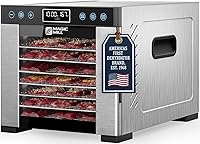
Magic Mill Food Dehydrator Machine: Best for thick-cut trail jerky
- 5 stackable stainless steel trays
- Adjustable tray spacing from 0.6 to 1.1 in
- 95 to 167 F temperature range
- 48-hour digital timer
Five adjustable stainless trays let you dry thick jerky and fruit leather in the same session. The 48-hour timer handles long, low drying runs without you watching the clock.
Pros
- Trays adjust to 1.1 in for thick cuts
- 48-hour timer
- Dishwasher-safe trays
- Stainless steel trays and base
Cons
- 240 W is modest for large batches
- Five trays fill fast for big trips
This Magic Mill suits a backpacker who dries thick jerky strips and fruit leather in the same session. Its five stainless steel trays sit 0.6 inches apart at the base setting and raise to 1.1 inches, so chunky ingredients get the clearance they need.
That flexibility means you can run thick meat strips on one shelf and thin fruit slices on another without swapping trays.
The digital panel sets temperatures from 95 to 167 F and runs a timer up to 48 hours. That covers a long, low overnight run for dried meals or a steady jerky session.
Magic Mill says the drying process keeps 97% of vitamins and minerals, which matters when trail food is your main nutrition.
At 240 W it dries more slowly than the higher-wattage models here, so expect longer runs when the stack is full. Trays come out for washing by hand or in a dishwasher.
The body is BPA-free plastic with a stainless steel base, so it stays lighter than full metal models.
Buy it for mixed loads of jerky, fruit and sauces at a modest counter footprint. Skip it if you dry for a group every week, since 240 W and five trays limit how much you finish in one run.
Cosori 10-Tray Stainless Steel: Best for bulk trip food
- 10 stainless steel trays
- 7.4 sq ft drying area
- Top window and interior light
- 46-recipe cookbook
Ten trays and 7.4 square feet of drying space suit a whole trip's meals in fewer runs. Horizontal airflow and 1 F temperature steps keep batches even across the stack.
Pros
- 7.4 sq ft drying area
- Horizontal airflow for even drying
- Dishwasher-safe trays
- 48-hour timer and auto shutoff
Cons
- Large counter footprint
- 640 W draws more power than smaller picks
The Cosori 10-tray is the pick when you prep a whole trip's food in one go. Ten stainless trays give 7.4 square feet of drying space, enough for several meals, fruit snacks and a batch of jerky without running the machine twice.
Cosori puts the capacity at up to 5.5 pounds of beef sliced 5 mm thick in a single batch.
Horizontal airflow moves heat across each tray, and temperature settings adjust in 1 F steps between 95 and 167 F. The top window and interior light let you watch progress without opening the door and losing heat.
Ten presets and a 46-recipe cookbook give you a starting point for trail meals and fruit rolls.
Cosori says the unit runs under 48 dB, so an overnight batch won't keep the house awake. Trays and removable parts are dishwasher-safe.
A fruit roll sheet and mesh tray are included. At 640 W it's the hungriest model here, which is the cost of all that space.
Buy it for group trips or weekly bulk drying. Skip it if your kitchen counter is tight or you only dry for one person, because the larger cabinet takes up real space.
Nesco FD-37 Food Dehydrator for Herbs: Best for herb and snack loads
- 4 trays, expands to 7
- 400 W drying power
- Clear top cover
- Fan-forced radial airflow
The clear round top and fan-forced airflow make this an easy first dehydrator for herbs and small snack batches. Trays expand to seven when your backpacking menu grows.
Pros
- Clear top for watching progress
- Expands from 4 to 7 trays
- No tray rotation needed
Cons
- Fixed temperature control
- Four trays cap small batches
The Nesco FD-37 is a simple round dehydrator that shines on herbs and small snack batches. Four trays ship in the box and the unit expands to seven, so you can grow capacity as your backpacking menu widens.
Its 400 W fan pushes heated air down the center and across each tray, and Nesco says no tray rotation is needed. A clear top cover lets you check drying progress without lifting the lid.
Sample seasoning and cure packs come included for a first jerky batch.
Temperature control is fixed, so you choose a drying time rather than dialing an exact heat. For herbs, fruit slices and simple jerky that's plenty.
For precise meal recipes or low-and-slow sauces, a digital model gives more control.
The round shape loads quickly and the clear cover is easy to watch. It's made in the USA with a one-year warranty.
Buy it for herbs and small snack batches at a low starting cost. Skip it if you need exact temperatures or large batches, because the fixed control and four trays limit both.
Cosori 6-Tray Stainless Steel: Best for everyday trail snacks
- 6 stainless steel trays
- 6.5 sq ft drying space
- 600 W rear-mounted fan
- 95 to 165 F control in 1 F steps
Six trays and a rear fan give this Cosori steady airflow for fruit rolls and jerky without a huge counter footprint. The 48-hour timer suits overnight drying before a trip.
Pros
- 1 F temperature steps
- Quiet brushless motor
- Dishwasher-safe trays
- 50-recipe cookbook
Cons
- 165 F top end limits some jerky recipes
- Six trays may need two runs for long trips
The Cosori 6-tray hits the middle ground for everyday trail snacks. Six stainless trays offer 6.5 square feet, enough for fruit rolls, vegetable chips and a jerky batch in a footprint that still fits a normal counter.
A 600 W motor and rear-mounted fan push air through the stack, and the brushless motor keeps noise under 48 dB. You can set temperatures from 95 to 165 F in 1 F steps and run the timer up to 48 hours.
A 50-recipe cookbook and a fruit roll sheet come included.
The 165 F top end is lower than the Magic Mill Pro's 176 F. For lean jerky that's fine, but very thick cuts may need more time.
Six trays cover a solo hiker's week in two runs. Cosori backs it with a two-year warranty.
Buy it for steady everyday snack drying with quiet operation. Skip it if jerky is your main output or you dry for several people at once.
PSIIDAN Food Dehydrator Machine: Best for even heat on long trips
- 8 stainless steel trays
- 650 W motor
- Temperatures up to 167 F
- 48-hour timer with auto shutoff
Eight trays and a 650 W motor handle a full week of backpacking food in one batch. Dual-layer insulation keeps the outside cool during long, unattended runs.
Pros
- 8 trays for large batches
- Dual-layer insulation
- Interior light
- Mesh tray and drip tray included
Cons
- Large footprint for small kitchens
- More trays than a solo hiker needs
The PSIIDAN is built for volume. Eight stainless trays and a 650 W motor let you dry a full week of backpacking food, including meat, fruit and sauces, in fewer sessions.
Temperatures reach 167 F and the timer runs to 48 hours with auto shutoff.
Dual-layer insulation keeps the exterior cool during long runs, which matters if the machine sits out overnight in a kitchen with kids around. An interior light lets you check progress without opening the door.
A mesh tray for small items and a drip tray for juicy foods are included, plus a recipe guide. The cabinet measures 13 by 13.31 by 12.01 inches.
The cabinet is bigger than the other picks, so measure your counter before buying. For a solo hiker, eight trays is more capacity than one trip needs.
For a pair or a group, it's the most efficient way to dry a shared food plan.
Buy it for shared trip food and long unattended runs. Skip it if you dry small batches or have limited counter space.
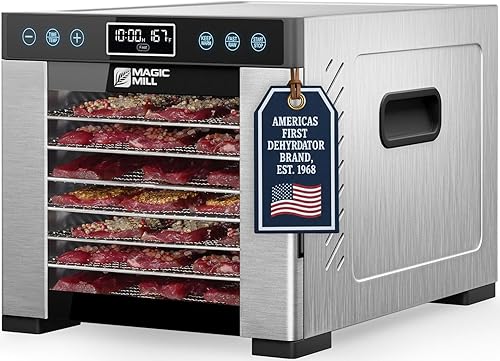
Magic Mill Pro 7-Tray Stainless Steel: Best for jerky-focused drying
- 7 full-size stainless steel trays
- 600 W rear fan
- 95 to 176 F in 1 F steps
- 48-hour timer and keep warm mode
The 176 F top end gives jerky makers more heat than most picks here. A full stainless build and rear fan suit repeated drying sessions before big trips.
Pros
- 176 F top temperature
- Full stainless inside and out
- Keep warm hold mode
- Rear fan for even drying
Cons
- Keep warm mode is more than backpacking needs
- Heavier build than plastic models
The Magic Mill Pro is the jerky specialist here. Its 176 F top end beats every other pick, and the full stainless build inside and out handles repeated high-heat sessions without plastic walls in the drying chamber.
Seven full-size trays plus two mesh screens and a fruit roll tray cover meat, herbs and leather in one stack. A rear fan pushes heat evenly across every tray, so there are no bottom hot spots and no tray rotation.
The 48-hour timer runs in 30-minute steps with auto shutoff, and the temperature dial moves in 1 F increments for repeatable jerky batches.
Keep Warm holds 95 F for up to 24 hours after a cycle ends. That's more than backpacking needs, but handy if you dry in the evening and pack the next morning.
The unit is ETL listed and BPA free. At 7.26 kg it's heavier than the plastic-bodied models.
Buy it for jerky-heavy trail food and repeat drying sessions. Skip it if you mostly dry fruit and herbs, where the extra heat range and weight aren't needed.
NESCO FD-41B Snackmaster Food Dehydrator for Easy: Best for simple beginner batches
- 4 mesh trays
- 400 W drying power
- 95 to 175 F range
- Top-mounted fan and heating element
Simple controls and four trays make this a low-effort starter for drying fruit and small jerky batches. The top-mounted fan keeps moisture away from the heating parts.
Pros
- Digital LED time and temperature controls
- Top-mounted fan reduces drips
- Mesh trays included
- Small counter footprint
Cons
- Only 4 trays
The NESCO FD-41B Snackmaster is the easiest starter in the group. Four mesh trays and a digital LED display with time and temperature controls within a 95-175 F range mean you set it and walk away.
A top-mounted fan and heating element keep moisture from dripping into the internal parts, which cuts mess on longer runs. Converga-Flow airflow spreads warm air evenly so trays finish together without rotation.
The temperature range runs 95 to 175 F and cycles on and off to hold heat. A metallic drip tray catches runoff.
It's compact enough to live on the counter. The trade-off is capacity: four trays suit a weekend of snacks or a small jerky batch, not a full week's meals.
It carries a one-year limited warranty, matching the Nesco FD-37 and shorter than the Cosori models' two years.
Buy it for a first dehydrator and simple snack batches. Skip it if you dry large meal plans or want exact temperature control.
How these food dehydrators for backpacking meals compare
The comparison table lines up trays, drying space, heat range and timer across all seven picks. Scan the columns that matter for your trips, then read the buying sections below for the details behind each number.
| Product | Best for | Trays | Temperature | Timer | Our score |
|---|---|---|---|---|---|
| Magic Mill Food Dehydrator Machine | thick-cut trail jerky | 5 | 95 to 167 F | 48 hours | 9.5 |
| Cosori 10-Tray Stainless Steel | bulk trip food | 10 | 95 to 167 F | 48 hours | 9.1 |
| Nesco FD-37 Food Dehydrator for Herbs | herb and snack loads | 4 (expands to 7) | 9.0 | ||
| Cosori 6-Tray Stainless Steel | everyday trail snacks | 6 | 95 to 165 F | 48 hours | 8.8 |
| PSIIDAN Food Dehydrator Machine | even heat on long trips | 8 | Up to 167 F | 48 hours | 8.7 |
| Magic Mill Pro 7-Tray Stainless Steel | jerky-focused drying | 7 | 95 to 176 F | 48 hours | 8.6 |
| NESCO FD-41B Snackmaster Food Dehydrator for Easy | simple beginner batches | 4 | 95 to 175 F | 8.5 |
How we compared these dehydrators
We compared the seven models on the specs that change how well they handle backpacking food: tray count and spacing, drying area, top temperature, timer length and airflow design. A dehydrator that stops at 165 F dries jerky more slowly than one that reaches 176 F, and adjustable tray spacing matters for thick meat strips and wet purees.
Wattage got weighed against batch size. A 650 W motor with eight trays dries more food per run than a 240 W unit with five, but it also pulls more from the outlet and takes up more counter.
Matching power to the amount you actually dry keeps runs short without buying capacity you won't fill.
Timer length got close attention too. A 48-hour timer lets you start a batch before bed and pack it in the morning.
Shorter runs force you to monitor the machine. We also weighed build materials, since stainless trays clean up better after sticky fruit leather and meat marinade.
Buyer feedback and the maker's stated features rounded out each score. Our score weighs specs, features and buyer feedback against what you're shopping for.
No model here was tested in person; the ranking comes from the published details and how each one fits trail food prep.
What should you look for in a food dehydrator for backpacking meals?
Start with a top temperature of at least 165 F and a timer that runs 12 hours or more. Those two specs decide whether you can dry jerky safely and finish a batch overnight.
Tray count and spacing come next, based on how much food you dry per trip.
How hot does a dehydrator need to get for trail food?
Jerky needs at least 165 F to dry safely. The Magic Mill Pro reaches 176 F, and the Nesco FD-41B reaches 175 F.
Models that stop at 165 F still work for lean, thin slices, but they need more time. Fruit and vegetable leather dries lower, around 135 to 145 F.
If you dry both in the same machine, a top end near 175 F covers everything without running two sessions.
How long should the timer run?
A 48-hour timer covers every job here, from a quick herb batch to a long jerky run. If you dry overnight, auto shutoff is the feature to check.
Every digital pick in this group has it. The Nesco FD-37 uses fixed timing instead, so you watch the clock yourself.
For a sauce-heavy meal that needs 12 hours or more, the longer timer matters more than the top temperature.
Do I need adjustable tray spacing?
Yes if you dry thick jerky strips or halved fruit. The Magic Mill Food Dehydrator Machine lifts its trays from 0.6 to 1.1 inches, which is the most flexible spacing here.
Fixed trays squeeze thick cuts and slow drying. Thin slices and herbs do fine on standard spacing.
If your trail menu is mostly fruit leather and thin slices, skip the adjustable model and spend the difference on trays.
Round or square trays for backpacking food?
Square trays pack rectangular meal portions and jerky strips with less wasted space. Round trays like the Nesco FD-37 are quick to load and easy to watch through a clear top.
For stacking several meals at once, square trays usually fit more food in the same footprint. Round trays make more sense when herbs and small snacks are the main job.
How much drying space does a week of trail food need?
Plan on six to eight trays for a week of meals for one person. That covers fruit, vegetables, meat and a sauce or two across separate runs.
The Cosori 10-tray and the PSIIDAN 8-tray handle that in one or two sessions. Solo hikers can start smaller and expand later.
Count your meals first, then match tray count to the number of runs you're willing to babysit.
Does wattage matter for trail food?
It matters for speed and for what your kitchen outlet can handle. The 240 W Magic Mill dries slowly but draws the least power.
The 600 W and 650 W models finish bigger stacks faster. If you dry overnight while the house sleeps, the lower draw is easier on a shared circuit.
Match wattage to batch size rather than buying the most powerful machine you can find.
Which food dehydrator suits which backpacker?
Solo weekend hikers do well with four to six trays. The Nesco FD-37 and the Cosori 6-tray keep the footprint small while covering snacks and a jerky batch.
Group trips need eight to ten trays, where the Cosori 10-tray and PSIIDAN earn their counter space.
Jerky makers should look at the top temperature first. The Magic Mill Pro's 176 F gives the most headroom, followed by the Nesco FD-41B at 175 F.
Fruit and herb dryers can stop lower and save money. A 165 F top end like the Cosori 6-tray is fine for thin, lean strips as long as you allow extra time.
Counter space is the other decider. The PSIIDAN and Cosori 10-tray are large machines.
The Magic Mill Food Dehydrator Machine and the Nesco FD-37 fit tighter kitchens without giving up the basics. Measure the spot where the machine will live before you commit to a ten-tray cabinet.
Can you dry full cooked meals in these dehydrators?
Yes, and that's the core job for backpacking food. Cook the meal, spread it thin on a fruit roll sheet or liner, and dry at 135 to 145 F until it's brittle.
Saucy dishes need a sheet so liquid stays put. Rehydrate on the trail with hot water and a 10-minute soak.
Rice and pasta dishes dry best when the sauce is thick and the pieces are small.
The fruit roll sheet and drip tray included with the Cosori 10-tray and the PSIIDAN make this easier. For the mechanics behind it, our guide on how does a food dehydrator work explains airflow and moisture removal.
If jerky is your main trail protein, our food dehydrator for jerky guide covers slicing, curing and heat settings in more detail. Garden growers who dry herbs and vegetables alongside trail food can compare models in our roundup of the best food dehydrators for herbs.
Buyers who want a full metal build should read the best stainless steel food dehydrators for the trade-offs.
Verdict: the best food dehydrator for backpacking meals
The Magic Mill Food Dehydrator Machine is the best food dehydrator for backpacking meals for most people, thanks to adjustable tray spacing, a 48-hour timer and a footprint that fits a normal kitchen. It handles jerky, fruit and sauces without forcing a second run.
Pick the Cosori 10-tray if you dry for a group or prep a whole week at once. Choose the Magic Mill Pro 7-tray if jerky is the main trail protein and you want the 176 F top end.
For a first machine on a tight counter, the Nesco FD-37 or the NESCO FD-41B keeps things simple and small.
Whichever you choose, start with one batch before a big trip. Learn how your machine dries fruit and meat, then scale up the recipe that packs lightest.
Our top 3 picks at a glance
-
1
-
2
-
3
Best for herb and snack loads
Nesco FD-37 Food Dehydrator for Herbs
9.0/10 our score
See it on Amazon
Frequently asked questions
What makes a dehydrator good for backpacking meals?
Look for even airflow, a temperature range that reaches at least 165 F for jerky, and a timer that runs long enough for overnight drying. Adjustable tray spacing helps when you dry thick meat strips or wet fruit purees.
How do I dehydrate a full backpacking meal?
Cook the meal as usual, then spread it thin on tray liners and dry at 135 to 145 F until it snaps or crumbles. Rehydrate on the trail with hot water and let it sit for about 10 minutes.
Saucy meals need a fruit roll sheet so the liquid stays on the tray.
Can I dry meat for backpacking in these dehydrators?
Yes, as long as the model reaches at least 165 F. Lean cuts work best, sliced thin and dried until firm with no soft spots.
The Magic Mill Pro reaches 176 F, which suits jerky better than models that stop at 165 F.
How many trays do I need for a week of trail food?
Plan on six to eight trays for a week of meals for one person. That covers fruit, vegetables, meat and a sauce or two across separate runs.
Solo hikers can start with four trays and expand later, while a group of two or more benefits from eight or ten trays.
Do backpacking meals need a fruit roll sheet?
Yes for saucy meals, purees and fruit leather. A fruit roll sheet or drip tray catches liquid that would otherwise run through the trays.
Several picks here include one, including the Cosori 10-tray and the PSIIDAN.
Is a round or square dehydrator better for trail food?
Square trays fit rectangular meal portions and jerky strips with less wasted space. Round trays like the Nesco FD-37 are easy to load and watch through the clear top.
For stacking several meals at once, square trays usually pack more food into the same footprint.