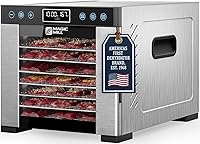
Food Dehydrators for Jerky: The Complete Guide
The best food dehydrator for jerky can hold 130 to 140°F, has enough trays for your usual batch and sets its temperature in small steps. USDA also asks you to heat the meat to 160°F before drying, and a food thermometer is how you check it.
On this page (21 sections)
- How we compared these machines
- How a food dehydrator dries jerky
- What the spec numbers mean
- Choose a food dehydrator by batch size
- Glass doors and chrome trays on the Excalibur
- Set the temperature for beef jerky
- Jerky how-to guides
- Deer and venison jerky in a dehydrator
- Best dehydrators for jerky roundups
- How to choose a food dehydrator
- Counter space and voltage for each machine
- Cleaning and care after each batch
- Side-by-side comparisons
- Single-model reviews
- Excalibur models explained
- Garden harvest drying
- Trays, mesh sheets and jerky seasoning
- Common mistakes with a food dehydrator for jerky
- Safety features to check before you buy
- Browse the five categories
- Which food dehydrator to buy for jerky
A food dehydrator for jerky is a countertop machine that dries thin strips of meat with low, steady heat. A fan moves the warm air across the trays, and the slow drying gives jerky its firm, chewy texture.
This guide sorts the machines by batch size, heat range and what else you plan to dry. Each section opens with a short answer, then links to a deeper guide for the step you need.
How we compared these machines
We compared the specs and features of each machine in this guide, including tray count, drying space, temperature range, timer, size and warranty. Our recommendations weigh those numbers against what you're drying.
Brand claims stay labeled as the brand's, so you can tell a spec from a promise. We research and compare, and we don't run the machines ourselves.
How a food dehydrator dries jerky
A food dehydrator dries jerky with a heater, a fan and a thermostat that hold one set temperature. The fan moves air across every tray, so moisture leaves the meat from all sides.
Why low, steady heat matters
Once the meat has been heated, drying is about moving moisture out with gentle heat and steady airflow. A control that holds its setting keeps that drying even from start to finish.
Why a dehydrator alone is not the whole plan
USDA points out that many dehydrator manuals leave out the pre-heat step for jerky. It also says a dehydrator on its own may not reach a temperature that kills bacteria.
So a food thermometer matters, and the manual that comes with your machine comes first. The temperature section below covers the numbers USDA gives.
What the spec numbers mean
Trays, drying space, temperature range, timer and warranty are the numbers that matter most when you compare a food dehydrator for jerky. Check each one before you weigh color, design or extras.
Tray count and drying space
Tray count tells you how many layers of meat fit, but drying space in square feet tells you the real work area. The Cosori 6-tray offers 6.5 square feet, while the Excalibur Select 6-tray offers 9.6 on the same six trays.
Temperature range and steps
The temperature range sets how low and how high a machine goes. The step size sets how exactly you can hit a number.
The Cosori 6-tray runs from 95 to 165°F, and the Magic Mill Pro 7-tray runs from 95 to 176°F, both in 1-degree steps.
Timer and auto shutoff
A timer marks the end of a cycle, and auto shutoff stops the heater when the time is up.
The Cosori 6-tray timer runs up to 48 hours, the Excalibur Select timer runs up to 60 hours, and the Magic Mill Pro 10-tray has a digital timer with auto shutoff.
Size, weight and warranty
Measure the height and depth before you choose a spot on the counter or shelf. The Magic Mill Pro 10-tray stands 14 inches tall and weighs 14 pounds, while the Excalibur Select 6-tray stands 17.32 inches tall and weighs 18.3 pounds.
Cosori backs its 6-tray with a two-year warranty, and Excalibur backs its Select 6-tray with a three-year limited warranty. Magic Mill gives the Pro 10-tray a one-year warranty.
Choose a food dehydrator by batch size
Count how much sliced meat you plan to dry in one session, then compare tray count and drying space before you buy. More trays hold more meat, but they also take up more counter space.
Batch size for a food dehydrator for jerky
Start with how many trays your usual batch fills, then pick a model with that many trays or a few more. Extra room lets you spread the strips out, which helps them dry evenly.
For a crowd, count the trays you can fill at once instead of the total pounds of meat. The trays set the limit on each run.
Six and seven tray models
The Cosori 6-tray stainless model has six stainless steel trays and 6.5 square feet of drying space. Its digital control runs from 95 to 165°F, and its timer goes up to 48 hours.
The Cosori measures 17.8 by 13.4 by 12.4 inches and weighs 18.1 pounds, so check your counter depth first.
The Magic Mill Pro 7-tray has seven full-size stainless steel trays, plus two mesh screens and a fruit roll tray. It runs from 95 to 176°F and weighs 7.26 kg (about 16 pounds).
Ten trays for big harvests
The Magic Mill Pro 10-tray has ten stainless steel trays, and Magic Mill says it also comes with a fruit leather sheet and mesh trays for small food such as nuts and herbs. It stands 14 inches tall, so measure the clearance under your cabinets first.
Magic Mill backs it with a one-year warranty, shorter than the two-year Cosori warranty, so weigh that if you plan to dry often.
Glass doors and chrome trays on the Excalibur
The Excalibur Select 6-tray pairs chrome plated trays with a stainless steel housing and clear glass doors. The doors let you check the drying without opening the unit.
Drying space and the thermostat
The Select 6-tray gives 9.6 square feet of drying space across six trays. Its thermostat runs from 85 to 165°F, and the timer goes up to 60 hours.
Excalibur says its Hyperwave Pulse technology and horizontal airflow dry food evenly without rotating the trays. Excalibur backs the unit with a three-year limited warranty.
Chrome trays compared with steel
The Select 6-tray's trays are chrome plated, and its construction is stainless steel. If you want stainless steel trays, the Cosori 6-tray and the Magic Mill Pro 7-tray both come with them.
Set the temperature for beef jerky
USDA advises heating meat to 160°F before drying, then holding the dehydrator at 130 to 140°F while the strips dry. Check the meat with a food thermometer, since the machine's air setting does not show the meat's temperature.
The 160°F pre-heat step
USDA's jerky guidance says meat should reach 160°F before the drying step, and poultry should reach 165°F. A food thermometer confirms it, so don't rely on color or time alone.
The USDA jerky and food safety page sets out these steps in full.
The 130 to 140°F drying range
Once the meat has reached 160°F, USDA's advice is to hold the dehydrator at 130 to 140°F while it dries the meat.
Most machines in this guide go well above that range. The control has to hold a low setting, not just reach a high one.
Look for steps you can set
The Cosori 6-tray and the Magic Mill Pro 7-tray both move in 1-degree steps, so you can set a number inside the drying range. Check the step size on any model before you buy, because a coarse control makes that harder.
Jerky how-to guides
The jerky guides cover the full process, the heat settings, the timing and how the machine works. Start with the process if you are new, then move to the heat settings before you set your machine.
- How to make jerky in a dehydrator, step by step: the full process, from slicing the meat to drying it.
- Dehydrator temperature for beef jerky: the pre-heat and drying settings in plain words.
- How long does jerky take in a dehydrator?: what changes drying time and how to judge doneness.
- Can you make jerky in a dehydrator?: when a dehydrator is the right tool for the job.
- How a food dehydrator works: the heater, fan and airflow behind the machine.
A simple order works well for a first batch. Learn how the machine moves air, then the heat rules, then the timing, then the steps for slicing and seasoning.
Deer and venison jerky in a dehydrator
USDA's jerky guidance applies to jerky made from meat, venison included, so follow it for deer jerky as you would for beef. This section covers the kitchen side only, from slicing and seasoning to trays and the machine.
- Deer jerky in a dehydrator: the kitchen steps for venison strips.
- Best dehydrators for deer and venison jerky: machines compared for game meat.
- How to choose a dehydrator for deer meat: what to check before you buy for game meat.
Slicing and seasoning venison
Thin, even slices dry faster and more evenly, so cut each strip to the same thickness. Hi Mountain says its Original Blend kit suits beef and wild game, and the kit includes a cure packet.
Follow the kit's own instructions for the cure, and follow USDA's guidance for heat once the strips are seasoned.
Using the same machine
The machine works the same way for venison strips as for beef. The trays, timer and temperature steps stay the same, while the meat and the seasoning change, so read the deer guides for the kitchen steps.
Because USDA's guidance covers jerky made from meat, the pre-heat and drying steps in the beef sections apply to deer jerky too. Check your machine's manual for its own settings, and keep a food thermometer on hand for the meat.
Best dehydrators for jerky roundups
Our roundups compare jerky dehydrators by specs and features, and each pick gets a clear best fit. Use them for a shortlist, then open a review or comparison before you buy.
- Best dehydrators for jerky: the main roundup for beef and venison jerky.
- Best stainless steel food dehydrators: models with stainless steel trays and housings.
- Best large food dehydrators (8 to 16 trays): models for big batches and harvests.
- Best commercial-style food dehydrators for home use: machines built in the commercial style for home kitchens.
How to choose a food dehydrator
Compare trays, watts and temperature range first: trays set how much jerky fits, and the temperature range sets how low you can hold the heat. The how to choose a food dehydrator guide covers all three in more detail.
Watts measure power, not drying alone
Wattage tells you how much power the heater and fan draw, which helps you compare machines. It does not show how evenly a machine dries, so look at the temperature control and the airflow too.
The Cosori 6-tray has a 600 W motor, and the Excalibur Select 6-tray is rated at 700 watts.
Counter space and voltage for each machine
These picks range from 10.8 to 17.32 inches tall, so measure the spot under your cabinets before you choose one. Each machine needs room for its depth and width too.
- Cosori 6-tray: 17.8 by 13.4 by 12.4 inches (depth, width and height).
- Magic Mill Pro 7-tray: 15.5 by 11.3 by 10.8 inches.
- Magic Mill Pro 10-tray: 15.5 by 11.5 by 14 inches.
- Excalibur Select 6-tray: 20.67 by 12.2 by 17.32 inches.
The Excalibur is the deepest of the four, so leave room in front for its doors to open. All four run on 120 volts, which is the standard household outlet in the United States.
Cleaning and care after each batch
Clean the trays after every batch, and check the manual for the housing before you wipe it down. Cleanup is easier when the parts go in the dishwasher.
Dishwasher-safe trays
The Cosori 6-tray includes six dishwasher-safe trays. The Magic Mill Pro 10-tray has dishwasher-safe trays and liners, so you can wash the parts in one load.
Housing and controls
The Magic Mill Pro 10-tray's housing can be wiped down with a damp cloth, so keep water away from the control panel. Let the unit cool and dry before you put it back on the counter.
Side-by-side comparisons
Head-to-head posts put two machines or two materials side by side, so you can compare trays, controls and fit for jerky. Use them once you know your batch size, so you compare the right pair.
- Cosori vs Excalibur dehydrator: the Cosori 6-tray and the Excalibur Select 6-tray.
- Cosori vs Magic Mill dehydrator: a Cosori 6-tray and a Magic Mill Pro 7-tray.
- Dehydrator vs oven for beef jerky: a countertop dryer compared with a home oven.
- Dehydrator vs smoker for beef jerky: a countertop dryer compared with an electric smoker.
- Stainless steel vs plastic tray dehydrators: how the tray material compares.
Single-model reviews
Each review looks at one machine, covering its build, size, controls, drying space and fit for jerky.
Read the one that matches your batch size, then compare its specs with a second model. The roundups show how each build stacks up against the rest.
- Cosori 6-tray stainless steel dehydrator review: one six-tray Cosori model.
- Magic Mill Pro 7-tray dehydrator review: a seven-tray stainless model.
- VEVOR 10-tray stainless steel dehydrator review: a 10-tray stainless model for big batches.
- Nesco Gardenmaster Pro 8-tray dehydrator review: an 8-tray model.
Excalibur models explained
Excalibur sells several dehydrators in more than one line, and the Select and Performance lines are easy to mix up. Sort them by tray count and controls before you compare them.
- Excalibur dehydrator models: Select vs Performance: sorts the two lines so you can match a model to your batch.
Garden harvest drying
Herbs, fruit and vegetables dry at different speeds, so each one needs its own doneness check. Start with the guide that matches what you harvested.
- How to dehydrate herbs from the garden
- How long to dehydrate fruit
- How to dehydrate vegetables from your garden
- Best food dehydrators for herbs and garden produce
Herbs are thin and leafy, so they usually dry faster than thick, juicy fruit. Fruit and vegetables need a closer look at each stage, which is why each one has its own guide.
Doneness for garden produce
Dried fruit should feel pliable and leathery, not sticky when you tear it. Dried vegetables should be brittle or crisp, and dried herbs should crumble easily.
Thin, even slices dry faster and more evenly, while juicy or whole pieces take longer. Check your manual's chart and the National Center for Home Food Preservation guidance for exact settings.
Mesh screens for herbs
Mesh screens keep herbs and small pieces from falling through the trays. The Magic Mill Pro 7-tray includes two mesh screens, and the Cosori 6-tray includes one.
Trays, mesh sheets and jerky seasoning
Trays, mesh sheets and seasoning kits change what you can dry, so count what comes in the box before you order extras. The Cosori 6-tray ships with six trays, one mesh screen and one fruit roll sheet, so any extra sheets are a separate buy.
Common mistakes with a food dehydrator for jerky
The usual mistakes are skipping the pre-heat, crowding the trays, cutting uneven slices and trusting the timer alone.
Skipping the pre-heat
A high setting on the machine does not replace the pre-heat step. USDA includes it because a dehydrator on its own may not reach a temperature that kills bacteria.
Crowded trays
Pieces that touch block the airflow, and the crowded spots dry more slowly. Leave a little space between strips, even if that means drying the batch in two rounds.
Uneven slices
Strips of different thickness finish at different times, so some pieces are ready while others still need time. Use the same knife for every cut and check the thickness as you go.
Trusting the timer alone
A timer marks the end of a cycle, not the dryness of every strip. Check several pieces after the timer goes off, and let them cool before you judge them.
Safety features to check before you buy
Auto shutoff and overheat protection are the two features to look for. Auto shutoff stops the heater when the timer ends, and overheat protection is meant to step in if the unit runs too hot.
The Excalibur Select 6-tray shuts off when the countdown ends, and so does the Magic Mill Pro 10-tray. Magic Mill says the Pro 7-tray has overheat protection that activates if the unit overheats.
Follow the manual for placement, and leave room around the unit for airflow.
Browse the five categories
The site groups its guides into five categories, each with its own roundups, comparisons and how-tos. Pick the category that matches what you plan to dry.
- Jerky dehydrators
- Venison and game meat
- Stainless and large dehydrators
- Garden harvest drying
- Brands and accessories
Which food dehydrator to buy for jerky
Pick the tray count that fits your batch, a control that holds 130 to 140°F and a thermometer you trust. Then match the machine to the kind of drying you do most.
- Pick the Cosori 6-tray if you want six stainless steel trays, 6.5 square feet of space and a timer that runs up to 48 hours.
- Pick the Magic Mill Pro 7-tray if you want seven full-size trays and a 1-degree control that reaches 176°F.
- Pick the Magic Mill Pro 10-tray if you dry large batches and have clearance for a 14-inch unit.
- Pick the Excalibur Select 6-tray if you want glass doors to watch the drying and you don't mind chrome trays.
Once you have a machine, read how to make jerky in a dehydrator for the steps, then check the heat rules before your first batch.
Frequently asked questions
What is the best food dehydrator for jerky?
No single machine is best for everyone, but a good jerky pick has a control that holds 130 to 140°F, enough trays for your usual batch and a timer you can trust. Start with batch size, then compare the temperature steps and drying space of each model.
Do you need a food dehydrator to make jerky?
No, you can also dry jerky in an oven or a smoker, but a dehydrator is the countertop option built for steady low heat. USDA's pre-heat step applies to home ovens and dehydrators alike, so check the heat rules and your manual whichever tool you pick.
What temperature should a food dehydrator be for jerky?
USDA advises heating meat to 160°F before drying, then holding the dehydrator at 130 to 140°F while the strips dry. Check the meat with a food thermometer, because the machine's air setting does not show the meat's temperature, and read your manual for the exact steps.
How many trays do you need for jerky?
Count how much sliced meat your usual batch fills, then choose a tray count that holds it in one session. The six-tray models in this guide offer between 6.5 and 9.6 square feet of drying space, and 10-tray models give more room for big harvests.