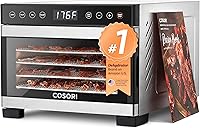
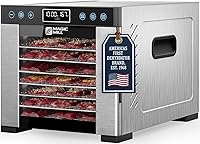
Cosori vs Magic Mill Dehydrator
The Magic Mill Pro 7-tray dehydrator reaches 176°F and has two mesh screens, while the Cosori 6-tray dehydrator has a 6.5 ft² drying area and a 2-year warranty. Both run at 600 watts with a 48-hour timer, so pick the one whose extras match your food.
On this page (20 sections)
- Cosori vs Magic Mill: the specs side by side
- Which top temperature do you need: 165°F or 176°F?
- How the controls compare
- Seven trays or six, and which screens come with them?
- Tray count and batch size for a family
- How big is each one on the counter?
- Stainless build and the housing
- Warranty: what Cosori covers and what to ask Magic Mill
- Recipes, screens and the drip tray
- Cleaning: are the trays dishwasher safe?
- Noise and running quiet
- Which one is the easier first dehydrator?
- If you want more trays from either brand
- Heat and airflow design
- Herbs or jerky: which job each one suits
- Who the Cosori 6-tray suits
- Who the Magic Mill Pro 7-tray suits
- Who should skip each one
- Check the box before you buy
- Cosori vs Magic Mill dehydrator: which to buy
Cosori vs Magic Mill dehydrator comes down to trays, top heat and counter size, since both run at 600 watts with a 48-hour timer.
The Magic Mill Pro 7-tray reaches 176°F and has a smaller body, while the Cosori 6-tray gives you a 6.5 ft² drying area, a cookbook and a 2-year warranty. We compared the published details and the parts in each box, not how either machine dries in use.
If jerky is your main use, our best dehydrators for jerky guide sets both in a wider field.

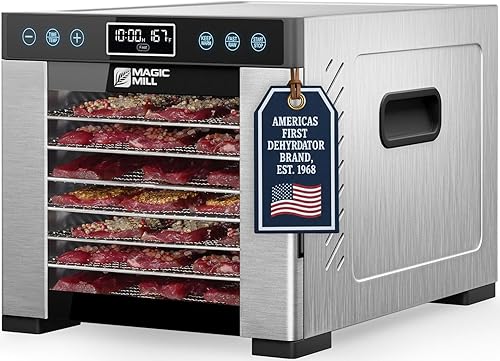 Best for a tighter counter and a 176°F top
Magic Mill Pro 7-Tray Stainless Steel
Cosori vs Magic Mill: the specs side by side
Both run at 600 watts with a 48-hour timer, so the differences are in the trays, the top temperature and the parts in the box. The Magic Mill has seven trays and a 176°F top, while the Cosori has six trays, a 165°F top and a 2-year warranty.
| Product | Best for | Trays | Power | Temperature range | Our score |
|---|---|---|---|---|---|
| Cosori 6-Tray Stainless Steel | a starter kit with 50 recipes | 6 | 600 W | 95 to 165°F | 8.6 |
| Magic Mill Pro 7-Tray Stainless Steel | a tighter counter and a 176°F top | 7 | 600 W | 95 to 176°F | 8.9 |
Here are the other numbers that separate them:
- Size: the Magic Mill is 15.5 in deep, 11.3 in wide and 10.8 in tall, and the Cosori is 17.8 in deep, 13.4 in wide and 12.4 in tall.
- Weight: about 16 lb for the Magic Mill and 18.1 lb for the Cosori.
- Screens: two mesh screens and a fruit roll and drip tray on the Magic Mill, one mesh screen and one fruit roll sheet on the Cosori.
- Model numbers: MFD-7700 for the Magic Mill and CP267-FD for the Cosori.
Which top temperature do you need: 165°F or 176°F?
The Magic Mill reaches 176°F, which is 11°F higher than the Cosori's 165°F top setting. Both start at 95°F, so the bottom of the range matches and the difference sits at the top.
Magic Mill describes its higher settings as made for jerky and chewy snacks. USDA's drying step for jerky sits at 130 to 140°F, which both dials cover, so check your manual and the National Center for Home Food Preservation guidance for the setting each food needs.
Dial precision on the Cosori and Magic Mill dehydrator
Both units adjust to the degree, so the dial is equally precise on each. The extra range at the top only helps if your guide calls for a setting above 165°F.
How the controls compare
The Magic Mill uses a digital control with 1-degree increments, a 48-hour timer in 30-minute steps and automatic shutoff. The Cosori uses a digital control panel that sets the temperature to the degree, with a 48-hour timer.
Both give you a precise setting, so the choice comes down to what each one does when a cycle ends.
Auto shutoff, overheat protection and Keep Warm
Magic Mill says the unit shuts off automatically when the timer ends, and it also has overheat protection. Magic Mill says its Keep Warm mode holds 95°F for up to 24 hours when a cycle ends.
Cosori doesn't describe an automatic shutoff for the 6-tray, so check its manual before you set a long run.
Seven trays or six, and which screens come with them?
The Magic Mill has seven full-size trays, two mesh screens and a fruit roll and drip tray. The Cosori has six trays, one mesh screen and one fruit roll sheet.
Two screens give you more room for herbs and small pieces in one batch. The drip tray also helps with fruit leather and marinades, per Magic Mill.
Mesh for herbs and small pieces
Herbs and small cuts need mesh so they don't fall through the trays. For how airflow moves food through a unit, see how a food dehydrator works.
Tray count and batch size for a family
If you dry a family batch, count the trays and their size. The Magic Mill's seven full-size trays give you one more tray, but Magic Mill gives no area in square feet, while the Cosori's six trays cover 6.5 ft².
A square-foot figure helps you plan a batch, since two machines with similar tray counts can hold different amounts. If you need to know how much the Magic Mill holds, ask Magic Mill for the square footage before you buy.
How big is each one on the counter?
The Magic Mill is 15.5 in deep, 11.3 in wide and 10.8 in tall, and it weighs about 16 lb. The Cosori is 17.8 in deep, 13.4 in wide and 12.4 in tall, and it weighs 18.1 lb.
The Magic Mill is about 2 in less in both width and depth, so its footprint is roughly a quarter smaller. It also stands 1.6 in lower, which helps under a cabinet.
Lifting and moving the unit
At about 16 lb, the Magic Mill is easier to lift than the 18.1 lb Cosori. Both run on 120 volts, so either one plugs into a regular kitchen outlet.
Stainless build and the housing
Both units use stainless steel. Cosori describes a stainless steel housing with stainless trays, and Magic Mill says its build is stainless steel inside and out, with 100% stainless steel trays.
Magic Mill also says the stainless trays are BPA free and that the unit is ETL Listed. Cosori doesn't make either claim for the 6-tray, so check its manual if those matter to you.
Warranty: what Cosori covers and what to ask Magic Mill
Cosori gives a 2-year manufacturer warranty. Magic Mill doesn't state a warranty length for the Pro 7, so ask before you buy.
Questions to ask Magic Mill before you buy
- How long is the warranty, and does it cover the trays?
- Is a drying area in square feet available for the Pro 7?
Recipes, screens and the drip tray
The Cosori's box includes a 50-recipe cookbook, which is the extra Magic Mill doesn't mention. The Magic Mill comes with two mesh screens and a fruit roll and drip tray, which is the extra the Cosori doesn't include.
Each box has one fruit-leather tray or sheet, so both cover that job. Cosori points buyers to extra accessories under the search term "Cosori Dehydrator Accessories", and Magic Mill doesn't mention extras.
Cleaning: are the trays dishwasher safe?
Cosori says its trays are dishwasher safe. Check the Magic Mill Pro 7 manual before you put its stainless trays in a dishwasher.
For more stainless picks, see best stainless steel food dehydrators.
Cleaning the drip tray and screens
Clean the drip tray and mesh screens after each run, since they catch the most residue. Check the manual before you put either part in a dishwasher.
Noise and running quiet
Cosori says its brushless motor runs below 48 dB. Magic Mill doesn't give a noise figure, so check its manual if quiet running matters to you.
Which one is the easier first dehydrator?
The Cosori comes with the most guidance, since the box holds a 50-recipe cookbook, a user manual and a quick reference guide. Cosori describes its control as a touch display, and the temperature sets to the degree.
The Magic Mill comes with more hardware, at seven trays and two mesh screens. Magic Mill says its dehydrator heritage goes back to 1968, which is a brand claim, so judge the unit by its parts.
If you want more trays from either brand
Both brands also sell 10-tray models. Cosori's 10-tray has 7.4 ft² of drying space at 640 watts, and Magic Mill's Pro 10-tray runs at 600 watts with mesh trays for herbs and nuts.
Our best food dehydrators for herbs and garden produce roundup compares both against five other units.
Heat and airflow design
Cosori describes a rear-mounted drying fan with horizontal airflow. Magic Mill describes a rear fan and rear heat that move air across every tray.
Both brands say their units dry without rotating the trays. These are brand descriptions, so read each manual for how to load the trays.
Herbs or jerky: which job each one suits
For herbs and small pieces, the Magic Mill's two mesh screens and its drip tray give you more of the parts you'll use. For jerky, the Magic Mill's 176°F top gives you more range at the high end, while the Cosori stops at 165°F.
Neither top setting replaces the pre-heat step. USDA's jerky guidance says to heat the meat to 160°F, checked with a food thermometer, before the drying step.
USDA also notes that many dehydrator manuals leave out the pre-heat step, and that a dehydrator on its own may not reach a temperature that kills bacteria. Read your manual alongside USDA's page, whichever unit you choose.
Who the Cosori 6-tray suits
The Cosori suits a cook who wants a known drying area, a cookbook and a warranty term on the box.
- A cook who wants a mesh screen and fruit roll sheet included.
- A counter with room for a 17.8 in deep unit.
- A buyer who wants a 2-year warranty term confirmed before purchase.
Our Cosori 6-tray review goes deeper on the unit.
Who the Magic Mill Pro 7-tray suits
The Magic Mill suits a cook who wants more trays, two mesh screens and a higher top setting.
- A cook who dries herbs and small pieces in one run.
- A counter with tight width, since the unit is 11.3 in wide.
- A cook who wants full stainless steel inside and out.
The Magic Mill Pro 7-tray review has the full build notes. For the wider field of jerky machines, see the food dehydrators for jerky guide.
Who should skip each one
Skip the Cosori if you need a top setting above 165°F or a smaller footprint on the counter. Skip the Magic Mill if you want a drying area in square feet or a warranty length you can read before you buy.
Check the box before you buy
The box matters as much as the specs here, since the two units differ on screens, sheets and a cookbook. Count the mesh screens, sheets and trays you'll use, then compare them with what each box holds.
- The Magic Mill Pro 7-tray includes two mesh screens and a fruit roll and drip tray.
- The Cosori 6-tray includes one mesh screen, one fruit roll sheet and a 50-recipe cookbook.
Cosori vs Magic Mill dehydrator: which to buy
Pick the Magic Mill if you want a higher top setting, two mesh screens and a tighter footprint. Pick the Cosori if you want a known drying area, a cookbook and a 2-year warranty.
- Pick the Cosori 6-tray if you want 6.5 ft² of drying space and a 2-year warranty.
- Pick the Magic Mill Pro 7-tray if you want two mesh screens and a 176°F top setting.
If you're also weighing the Excalibur, our Cosori vs Excalibur comparison covers that match-up. For more brand picks, see the brands and accessories section.
Frequently asked questions
Does the Magic Mill Pro 7-tray get hotter than the Cosori 6-tray?
Yes, the Magic Mill Pro 7-tray goes up to 176°F while the Cosori 6-tray tops out at 165°F. Both start at 95°F and adjust in 1°F steps, so the gap sits at the top and only matters if your guide calls for a setting that high.
Which one is smaller on the counter?
The Magic Mill Pro 7-tray is smaller, at 15.5 in deep, 11.3 in wide and 10.8 in tall. The Cosori 6-tray measures 17.8 in deep, 13.4 in wide and 12.4 in tall, so it needs more room on the counter and weighs about 2 lb more.
Which one has a longer warranty?
Cosori gives a 2-year manufacturer warranty. Magic Mill doesn't state a warranty length for the Pro 7, so ask Magic Mill for the term and the coverage before you buy, and get the answer in writing if the warranty matters to your decision.
Do both come with mesh screens?
Yes, the Magic Mill Pro 7-tray includes two mesh screens and a fruit roll and drip tray, while the Cosori 6-tray includes one mesh screen and a fruit roll sheet. Two screens give you more room for herbs and small pieces in a single batch.