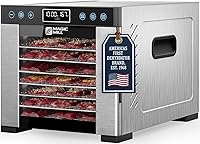
Best Food Dehydrator for Home Use: How to Choose
The best food dehydrator for home use has enough trays for your usual batch, a temperature range that covers your foods and a timer you can rely on. Check the fan position, the build and the counter footprint next.
On this page (14 sections)
- How many trays does a food dehydrator for home use need?
- How many watts does a food dehydrator need?
- What temperature range should a home dehydrator have?
- What timer and shutoff features should you check?
- Where the fan sits and how the air moves
- Stainless steel or plastic: what the build means
- Which warranties come with these models?
- How quiet do these dehydrators run?
- Which display and controls suit your routine?
- How big is the machine on your counter?
- What comes in the box with each machine?
- Does the food you dry change which dehydrator to buy?
- The five models side by side
- Which food dehydrator for home use should you pick?
The best food dehydrator for home use matches your usual batch: enough trays, a temperature range that covers your foods and a timer you can set. Jerky, fruit, herbs and garden vegetables rarely need the same machine.
This guide walks through trays, watts, temperature range, timer and fan position. The examples are the Cosori 6-tray, Excalibur Select 6-tray, Magic Mill Pro 7-tray, Magic Mill Premium 10-tray and Nesco Gardenmaster Pro 8-tray.
If you dry mostly jerky, start with the food dehydrators for jerky guide.
How many trays does a food dehydrator for home use need?
Count the trays you fill in a normal session, then add one or two for room to grow. Many home batches fit in 6 to 8 trays, while big harvests or bulk meat push you toward 10.
The Cosori 6-tray stainless model has 6.5 square feet of drying space, and the Excalibur Select 6-tray has 9.6. Tray count alone doesn't set the space, because tray size changes how much fits.
Home use: tray size and drying space
Two machines with the same tray count can hold very different amounts, so compare square footage whenever the maker gives it. Nesco doesn't give an area, which makes its 8 trays harder to compare on paper.
When a bigger food dehydrator for home use helps
If you dry bulk harvests or large batches of meat, a bigger machine saves you a second run. The best large food dehydrators roundup covers the bigger models, and heavy users may also look at commercial-style food dehydrators for home use.
The Magic Mill Premium has 10 extra-large stainless trays and a 48-hour timer. Magic Mill says all its trays and the liner are dishwasher safe, which makes cleanup after a big batch simpler.
How many watts does a food dehydrator need?
Watts show how much power the machine draws, but they don't score how well it dries food. Treat them as one clue next to tray count, temperature range and fan design.
The Nesco Gardenmaster Pro is rated at 1,000 watts, the Excalibur Select and Magic Mill Premium at 700, and the Magic Mill Pro and Cosori at 600. The same number can sit in very different machines, so don't buy on watts alone.
For a closer look at the Nesco, read our Nesco Gardenmaster review. If the heater and fan roles are new to you, how a food dehydrator works explains the basics.
What temperature range should a home dehydrator have?
Look for a thermostat that starts near 95°F and reaches the settings your recipes call for. Among these five models, the range runs from 85°F at the low end to 176°F at the high end.
The Magic Mill Pro runs from 95°F to 176°F in 1-degree steps, the highest top setting in this guide. The Cosori runs from 95°F to 165°F with control down to the degree, and the Magic Mill Premium runs from 95°F to 167°F.
The Excalibur Select starts lowest at 85°F and tops out at 165°F. The Nesco runs from 95°F to 160°F, the lowest top setting of the five.
Glass French doors let you check progress without opening the machine. For the Select and Performance lines, see Excalibur dehydrator models.
What timer and shutoff features should you check?
Check the longest timer setting and whether the machine shuts off on its own when a cycle ends. Cosori has a timer of up to 48 hours, and the Excalibur Select goes up to 60 hours with automatic shutoff when drying is complete.
Both Magic Mill models have a 48-hour timer with automatic shutoff and overheat protection. Nesco doesn't mention a timer, so check its manual before you plan a long cycle.
Shutoff and keep warm settings
A shutoff ends the cycle for you, which helps when you can't be in the kitchen at the exact minute. Confirm how it works in the manual before you rely on it.
Both Magic Mill models also have a keep warm mode that runs for up to 24 hours after the cycle ends.
Where the fan sits and how the air moves
The fan position decides how air reaches each tray. Cosori and both Magic Mill models put the fan at the rear, and Cosori describes horizontal airflow.
Nesco puts the fan on top and calls its system Converga-Flow. Excalibur uses Horizontal Parallex Air Flow with Hyperwave Pulse Technology, which Excalibur calls patented.
Every brand says its airflow dries food evenly without you rotating the trays. Since all of them make that claim, check your first batch for even results.
Stainless steel or plastic: what the build means
Four of the five models here use stainless steel for the housing or the trays, and the Nesco is the one with a plastic body. Stainless steel vs plastic tray dehydrators covers the trade-offs, and best stainless steel food dehydrators lists more metal-tray choices.
Magic Mill says the Pro is stainless inside and out, with 100% stainless steel trays. It also says the Pro is ETL listed for safety.
Dishwasher-safe trays and easy wipe-downs
Cosori's 6 trays are dishwasher safe, and so are the Magic Mill Premium's trays and liner. Magic Mill says the Premium housing wipes clean with a damp cloth, so the body is a wipe-down job rather than a dishwasher one.
Which warranties come with these models?
The Excalibur Select has a 3-year limited warranty, the Cosori has 2 years from the manufacturer, and the Magic Mill Premium has a 1-year limited warranty. Terms differ, so weigh them next to the build.
Magic Mill and Nesco don't state a term for the Pro and the Gardenmaster, so read the paperwork for both before you buy.
How quiet do these dehydrators run?
Cosori says its motor runs below 48 dB, and Magic Mill calls the Premium whisper-quiet. The other models don't give a noise figure, so ask the maker if the machine will sit in an open-plan kitchen or near a bedroom.
Which display and controls suit your routine?
Four of the five models have a digital panel or display, and the Nesco has an adjustable thermostat. A panel with a visible countdown helps when you check a long cycle from across the kitchen.
Cosori has a touch-control display, and Excalibur has an LED control panel with the countdown on screen. Both Magic Mill models use a digital control system with a keep warm setting.
A clear screen is useful if you change settings often. A plain thermostat works well if you set one temperature and leave it.
How big is the machine on your counter?
Measure your space before you order, because the footprints differ a lot. The Magic Mill Pro is the smallest of the five at 15.5 inches deep, 11.3 inches wide and 10.8 inches tall.
The Excalibur measures 20.67 inches deep and 17.32 inches tall, so it is the deepest and tallest. Of the four with published weights, the Magic Mill Pro is lightest at about 16 pounds and the Premium heaviest at 20.5 pounds.
The Cosori weighs 18.1 pounds and the Excalibur 18.3 pounds. The Nesco is 17 inches deep, 15.5 inches wide and 14 inches tall, and it has no published weight.
What comes in the box with each machine?
The Nesco comes with the most extras, and the Magic Mill Premium's data names the fewest. Check the box contents, because mesh screens and fruit roll sheets are the accessories you'll reach for first.
The Nesco includes 8 fruit roll sheets, 8 Clean-A-Screens, a jerky seasoning and cure sample and a 52-page recipe book. The Cosori includes 1 mesh screen, 1 fruit roll sheet and a 50-recipe cookbook.
The Magic Mill Pro includes 2 mesh screens and 1 fruit roll and drip tray. Magic Mill says the screens are for herbs and small items and the tray is for fruit leather.
The Excalibur Select includes its 6 chrome trays and the Preserve It Naturally book. The Premium has a liner, but no extra sheets or screens are named.
Does the food you dry change which dehydrator to buy?
Yes, mostly through tray count and the pre-heat step for meat. Jerky makers should read the safety steps first, and garden growers should put drying space first.
Jerky: the pre-heat step comes first
For jerky made from meat, USDA advises heating the meat to 160°F before the dehydrating step, checked with a food thermometer. It then advises holding the dehydrator at 130 to 140°F while the meat dries.
USDA notes that many dehydrator manuals leave out the pre-heat step. It adds that a dehydrator on its own may not reach a temperature that is high enough to heat meat to 160°F.
Read USDA's jerky and food safety guidance and your manual before you dry any meat.
Fruit, vegetables and herbs: space and even slices
Garden harvests arrive in big batches, so tray count and drying space matter most. Thin, even slices dry faster and more evenly than thick ones, and juicy or whole pieces take longer.
Dried fruit should feel pliable and leathery, not sticky or wet when torn. Vegetables should be brittle or crisp, and herbs should crumble easily.
The National Center for Home Food Preservation has drying charts to check against your manual. For models picked for garden work, see best food dehydrators for herbs and garden produce.
The five models side by side
The Nesco has the most watts, and the Magic Mill Pro has the highest top setting. The table sets the main numbers next to each other, so you can compare them without going back through the sections.
| Model | Trays | Power | Temperature range | Timer | Housing |
|---|---|---|---|---|---|
| Cosori 6-Tray Stainless Steel | 6 | 600-watt motor | 95°F to 165°F | Up to 48 hours | Stainless steel |
| Magic Mill Pro 7-Tray | 7 | 600 watts | 95°F to 176°F | 48 hours | Stainless steel |
| Excalibur Select 6-Tray | 6 | 700 watts | 85°F to 165°F | Up to 60 hours | Glass and stainless steel |
| Magic Mill Premium 10-Tray | 10 | 700 watts | 95°F to 167°F | 48 hours | Stainless steel |
| Nesco Gardenmaster Pro 8-Tray | 8 | 1,000 watts | 95°F to 160°F | Not mentioned | Plastic |
Which food dehydrator for home use should you pick?
Pick the machine whose tray count, temperature range and timer match your batches, then choose the build you want to clean. For jerky-first comparisons, see best dehydrators for jerky.
If you want a full stainless build and 1-degree control
Magic Mill's 7-tray Pro is stainless inside and out, with 7 full-size trays, a 48-hour timer and temperatures from 95°F to 176°F in 1-degree steps. For a closer look, read the Magic Mill Pro 7-tray review.
If you want a smaller 6-tray stainless machine
The Cosori 6-tray is the pick if you want a stainless housing and a timer of up to 48 hours. Its 6.5 square feet of drying space sits below the Excalibur's 9.6, so check it against your largest batch.
The Cosori 6-tray stainless steel review has the full specs.
If you want the most trays
The Magic Mill Premium has the most trays in this guide at 10, and the Nesco has 8 trays with the most watts. Compare them on tray space and on the temperature range you need, not on watts alone.
Quick rules for the best food dehydrator for home use
- Pick the Cosori if you want a 6-tray stainless machine with a 48-hour timer.
- Pick the Excalibur Select if you want glass doors and a range that starts at 85°F.
- Pick the Magic Mill Premium if you need 10 trays and dishwasher-safe trays.
- Pick the Magic Mill Pro if you want a full stainless build and 1-degree control.
- Pick the Nesco Gardenmaster Pro if you want 8 trays, 1,000 watts and fruit roll sheets in the box.
If you dry deer meat, read how to choose a dehydrator for deer meat next, and browse more jerky dehydrator picks.
Frequently asked questions
What size food dehydrator is best for home use?
Many home cooks start with 6 to 8 trays, which covers a normal batch of jerky, fruit or herbs. Move up to 10 trays for large harvests or bulk meat, and measure your counter first, since the models in this guide run from 15.5 to 20.67 inches deep.
Do watts matter when you choose a food dehydrator?
Watts hint at power but don't predict how well a machine dries, so use them as one clue next to trays, temperature range and fan design. The Nesco is rated at 1,000 watts, the Excalibur Select and Magic Mill Premium at 700, and the Magic Mill Pro and Cosori at 600.
What temperature range do I need for a home dehydrator?
Pick a range that includes the settings your recipes call for: the Nesco runs 95°F to 160°F, the Cosori 95°F to 165°F, the Magic Mill Premium 95°F to 167°F, the Magic Mill Pro 95°F to 176°F and the Excalibur Select 85°F to 165°F. All five cover USDA's 130 to 140°F jerky drying range.
Should I buy a stainless steel or plastic food dehydrator?
Four of the five models in this guide use stainless steel for the housing or the trays, and the Nesco Gardenmaster Pro has a plastic body. Compare the material, the cleaning steps and the temperature range for your foods, and check each manual for care instructions before you decide.