How to Choose a Dehydrator for Deer and Other Game Meat
For deer meat, choose a dehydrator by tray count, temperature range and timer, then add a slicer or sealer only if your routine needs one. USDA's jerky guidance covers jerky made from meat, so follow it along with your dehydrator's manual.
On this page (15 sections)
- Does USDA's jerky guidance apply to deer jerky?
- Why the dehydrator is one step, not the whole process
- How many trays does a deer meat batch need?
- Cosori 6-tray vs Magic Mill Pro 7-tray for deer meat
- What temperature range should a deer meat dehydrator have?
- What should the timer do on a deer meat dehydrator?
- Does a meat slicer help with even strips?
- How should you season and marinate deer meat before drying?
- Do you need a slicer, a sealer or neither?
- What are the kitchen steps in order?
- Where should the dehydrator sit, and what does it run on?
- What should you clean after each job?
- Can the same dehydrator handle fruit and garden harvests?
- Which deer meat dehydrator should you pick?
- Checklist before you buy a dehydrator for deer meat
A dehydrator for deer meat is the same machine you'd use for beef jerky, so the choice comes down to tray space, temperature range and a timer you can trust. This guide covers the kitchen side only: slicing, trimming, seasoning, trays and the dehydrator itself.
For the basics of drying, read how to make jerky in a dehydrator. The wider picture of machines is in the food dehydrators for jerky guide.
Does USDA's jerky guidance apply to deer jerky?
Yes. USDA's jerky guidance is written for jerky made from meat, so follow it for deer as you would for beef.
USDA advises heating meat to 160°F before the dehydrating step, checked with a food thermometer. It then advises holding the dehydrator at 130 to 140°F while the meat dries.
You can read the full guidance on USDA's jerky and food safety page. For the process from start to finish, see deer jerky in a dehydrator.
Why the pre-heat step needs a thermometer
The dehydrator's setting controls the air temperature, not the temperature inside the meat. An instant-read food thermometer tells you what the meat has reached, and the machine's manual comes first for its own settings.
Why the dehydrator is one step, not the whole process
The dehydrator handles the drying, and the pre-heat step handles the heat-up before it. USDA notes that many dehydrator manuals leave out the pre-heat step.
USDA adds that a dehydrator on its own may not reach a temperature that is high enough to heat meat to 160°F. Plan the pre-heat into your routine before you load the trays, so the meat is ready when the dehydrator is set.
How many trays does a deer meat batch need?
Plan one layer of sliced meat per tray, with air space between the pieces. Tray count sets the number of layers, and drying space sets how much fits in one run.
Cosori's 6-tray stainless model has 6.5 square feet of drying space, which suits a smaller batch.
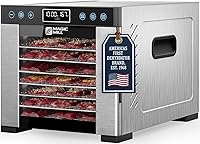
The Magic Mill Pro has 7 full-size stainless trays, and Magic Mill's Premium has 10 extra-large trays for bigger batches. For a wider set of tray choices, see best dehydrators for jerky.
Tray size for a deer meat batch
Two machines with the same tray count can hold different amounts, so compare square footage when the maker gives it. Count your largest batch in layers first, then check that the model's space fits it.
Magic Mill doesn't give a drying area for the Pro, so tray count and tray size are your guide there.
Cosori 6-tray vs Magic Mill Pro 7-tray for deer meat
The Magic Mill Pro has one more tray, a higher top setting and a smaller footprint. The Cosori gives you a published drying area and a 2-year manufacturer warranty.
| Feature | Cosori 6-tray | Magic Mill Pro 7-tray |
|---|---|---|
| Trays | 6 stainless steel | 7 stainless steel |
| Drying space | 6.5 square feet | Not stated |
| Power | 600-watt motor | 600 watts |
| Temperature range | 95°F to 165°F | 95°F to 176°F |
| Timer | Up to 48 hours | 48 hours, with automatic shutoff |
| Fan | Rear-mounted | Rear-mounted |
| Size (deep x wide x tall) | 17.8 x 13.4 x 12.4 inches | 15.5 x 11.3 x 10.8 inches |
| Weight | 18.1 pounds | About 16 pounds |
What temperature range should a deer meat dehydrator have?
The range has to include the 130 to 140°F window USDA gives for drying, and both machines named here do. Look for a thermostat with steps you can set, so you can hold that window without guessing.
The Magic Mill Pro runs from 95°F to 176°F in 1-degree steps, the widest range of the two. Cosori runs from 95°F to 165°F and also controls down to the degree.
For the temperature facts specific to beef jerky, see dehydrator temperature for beef jerky.
What should the timer do on a deer meat dehydrator?
Pick a timer long enough for your recipe, and look for an automatic shutoff when the cycle ends. Cosori has a timer of up to 48 hours.
The Magic Mill Pro has a 48-hour timer in 30-minute steps, then shuts off automatically. For drying-time questions, see how long jerky takes in a dehydrator rather than relying on a single number.
Does a meat slicer help with even strips?
A slicer helps you cut thin, even strips, and thin, even slices dry faster and more evenly than thick, uneven ones. A sharp knife can do the job too, if you keep the strips even.
Cutting across the grain gives a more tender bite, and cutting with the grain gives a chewier strip. Either way, keep the thickness the same from piece to piece.
The CUSIMAX has an 8.7-inch blade, a 200-watt motor and a thickness knob that adjusts from 1 to 20 mm. CUSIMAX's instructions say to keep the food pusher in place and not to run the slicer for more than 7 minutes at a stretch.
The blade, food pusher and food carriage all come off for cleaning, and the manual has the care steps.
Slicer or knife: which one to buy for deer meat
Buy the slicer if you dry often and want strips that match from batch to batch. A sharp knife is enough for an occasional batch.
The CUSIMAX measures 17.72 x 12 x 14.13 inches and weighs 10.8 pounds, so it needs a storage spot as well as counter space while you slice.
Trim the fat before you slice
Trim visible fat and any tough silver skin before you slice, so the strips cut evenly. Keep your fingers clear of the blade and use the food pusher, not your hand, to feed the meat.
How should you season and marinate deer meat before drying?
Season the meat in a bowl or a bag, and follow the label on any seasoning kit exactly. If the kit includes a cure, use only the amounts printed on its label and never amounts from another recipe.
Mix the seasoning before it touches the meat, so each piece gets the same blend rather than a pinch here and there. For kit options, see best jerky seasoning kits for a dehydrator.
Marinating in a sealed bag
A vacuum sealer can seal meat in a bag along with its marinade. Gasbye says its pulse mode helps keep liquid in the bag when you seal moist foods.
The kit has 5 pre-cut bags, two bag rolls and a built-in cutter, so you can make a bag to size. Gasbye sells a compatible container for saucy marinades separately, and it isn't in the box.
The Gasbye is compact at 15.7 x 7.8 x 4.7 inches and 6.5 pounds, and Gasbye offers 5-year quality coverage.
Letting marinated strips drain
Marinated strips drip, so let the extra marinade run off before you load the trays. Magic Mill says the Pro's fruit roll and drip tray is for fruit leather, marinades and easy cleanup.
The Pro also comes with 2 mesh screens, which Magic Mill says are for herbs and small items.
Do you need a slicer, a sealer or neither?
Neither is required, and a dehydrator, a sharp knife and a bowl are enough to start. Add a slicer when you want strips that match from batch to batch, and add a sealer when you marinate in bags.
Skip the slicer if you dry deer meat only now and then, since it takes storage space. Skip the sealer if you marinate in a bowl and have no other use for the bags.
What are the kitchen steps in order?
Work through the steps in order, and check each one against your manual before the first batch. Each step changes what the next one needs.
- Trim the visible fat and any tough silver skin.
- Slice the meat into even pieces with a slicer or a sharp knife.
- Season or marinate, following the label on any kit.
- Pre-heat the meat to 160°F as USDA advises, and check it with a food thermometer.
- Load the trays in a single layer with air space between pieces, then dry at 130 to 140°F as USDA advises.
Where should the dehydrator sit, and what does it run on?
Put the dehydrator on a stable counter with clear space around it, and plug it into a standard outlet. Every machine named in this guide runs on 120 volts, so a regular household outlet is what you need.
Leave room around the unit so the fan and vents aren't blocked, and check the manual for the exact clearance. Cosori says its motor runs below 48 dB, while Magic Mill doesn't give a noise figure for the Pro.
What should you clean after each job?
Cleaning is simplest when you know which parts come off. Cosori's 6 trays are dishwasher-safe, and Magic Mill doesn't say whether the Pro's trays are, so check its manual.
The CUSIMAX slicer's blade, food pusher and food carriage come off, and the Gasbye sealer has a removable drip tray. Follow each manual for care steps.
Can the same dehydrator handle fruit and garden harvests?
Yes, both machines named here also dry fruit, herbs and vegetables. Magic Mill says the Pro suits jerky, fruit, herbs and batch drying, and the Cosori comes with a fruit roll sheet and a mesh screen.
Both have stainless steel trays. If plastic trays tempt you, stainless steel vs plastic tray dehydrators explains the trade-offs, and the best food dehydrators for herbs and garden produce roundup picks machines for garden work.
Which deer meat dehydrator should you pick?
Pick by batch size and temperature control first, since those two numbers decide the most for a home kitchen. The Magic Mill Pro suits a cook who wants fine control and a full stainless build, while the Cosori suits a smaller 6-tray setup.
For ready-made comparisons, see best dehydrators for deer and venison jerky. For a wider look at features, see how to choose a food dehydrator.
If you want 1-degree control and a full stainless build
Magic Mill says the Pro is stainless inside and out, with 100% stainless steel trays and a rear-mounted fan. It has 7 full-size trays, 2 mesh screens and a fruit roll and drip tray.
It also has a 48-hour timer and a keep warm mode for up to 24 hours. For a closer look, read the Magic Mill Pro 7-tray review.
If you want a smaller 6-tray stainless machine
The Cosori has a stainless steel housing, 6 dishwasher-safe trays and a timer of up to 48 hours. It has the fewest trays of the machines named here, so it fits best if you don't need 7 or 10.
Checklist before you buy a dehydrator for deer meat
Check five things before you buy a dehydrator for deer meat: tray count, temperature range, timer, the manual's pre-heat guidance and a food thermometer.
- A tray count that fits your largest batch of sliced meat
- A range that includes the 130 to 140°F window USDA gives for drying
- A timer long enough for your recipe, with automatic shutoff
- The manual's pre-heat steps, read before the first batch
- An instant-read food thermometer for checking the meat
For more kitchen guides on game meat, browse the venison and game meat category.
Frequently asked questions
What kind of dehydrator is best for deer meat?
Look for enough trays for your largest batch, a range that includes USDA's 130 to 140°F drying window and a timer you can set, which the Magic Mill Pro and the Cosori 6-tray both offer. Read your manual's pre-heat steps first, since USDA advises heating meat to 160°F before drying.
Does venison need a different temperature than beef jerky?
This guide doesn't set a different temperature for venison, because USDA's jerky guidance applies to jerky made from meat. Heat the meat to 160°F, checked with a food thermometer, then hold the dehydrator at 130 to 140°F while it dries, and let your manual cover the machine's own settings.
Do I need a meat slicer to make deer jerky?
You don't need one, since a sharp knife can cut strips, but a slicer makes thin, even strips easier to repeat. The CUSIMAX slicer has a 200-watt motor and a thickness knob that adjusts from 1 to 20 mm, and thin, even slices dry faster and more evenly.
Can I vacuum seal marinated meat before drying?
A vacuum sealer can seal meat in a marinade bag, and Gasbye says its pulse mode helps keep liquid in the bag with moist foods. If a seasoning kit includes a cure, use only the amounts printed on its label, and ask Gasbye about its separate container for saucy marinades.