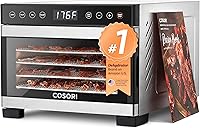
Dehydrator vs Oven for Beef Jerky
Dehydrator vs oven for beef jerky comes down to focus: a dedicated dehydrator with a 95 to 176°F dial and five trays, or a Breville oven that dehydrates up to 4 trays at once. Either method needs the USDA pre-heat step before drying, so a food thermometer is part of both.
On this page (22 sections)
- Dehydrator vs oven: the specs side by side
- Which one holds a low, steady setting for drying?
- How the air moves: a rear fan against super convection
- How many trays and how much room for a batch?
- Watching the batch and the light
- Counter space and weight
- What to clean after a batch
- Does the pre-heat step apply to both methods?
- How a regular full-size oven compares
- Warranty and support
- What to look up in the Breville manual
- When an oven is the right tool
- Occasional jerky or a weekly routine?
- What the oven gives you beyond jerky
- The Cosori's four presets
- Who the Cosori 5-tray suits
- Who the Breville Smart Oven Air Fryer Pro suits
- Who should skip each one
- Jerky strips on a tray or a basket rack
- Accessories in each box
- Check these four things before you buy
- Dehydrator or oven for beef jerky: which to buy
Dehydrator vs oven for beef jerky comes down to focus. The Cosori 5-tray is a dedicated dehydrator with a 1-degree dial, while the Breville Smart Oven Air Fryer Pro is an oven that dehydrates up to 4 trays at once.
We compared the published details of a 5-tray dehydrator and a multi-function oven, looking at trays, airflow, heat settings and what's in the box. This doesn't judge how jerky turns out in either machine, only what each one offers.
Whichever machine you pick, USDA's jerky guidance applies, and it's covered in the pre-heat section below. For more on the basics, see our food dehydrators for jerky guide.

 Best for an oven that also dehydrates
Breville Smart Oven Air Fryer Pro
Dehydrator vs oven: the specs side by side
The Cosori has five trays and a 95 to 176°F dial, while the Breville has a dehydrate setting and a mesh basket rack for up to 4 trays. Breville doesn't publish a dehydrate temperature range, so check its manual before you set it for jerky.
| Product | Best for | Trays | Power | Temperature range | Our score |
|---|---|---|---|---|---|
| Cosori 5-Tray Stainless Steel | a dedicated jerky dryer | 5 | 480 W | 95 to 176°F | 8.8 |
| Breville Smart Oven Air Fryer Pro | an oven that also dehydrates | Up to 4 at once | 1800 W | Check the manual | 8.1 |
The table shows the shared specs. These are the other differences that matter on a counter:
- Power: 480 watts for the Cosori and 1800 watts for the Breville.
- Size: the Cosori is 13.9 in deep, 11.3 in wide and 8.9 in tall, and the Breville is 17.5 in deep, 21.5 in wide and 12.7 in tall.
- Weight: 10.8 lb for the Cosori and 30.2 lb for the Breville.
- Warranty: 2 years on each, manufacturer for Cosori and limited for Breville.
Which one holds a low, steady setting for drying?
The Cosori is built around drying, and its dial starts at 95°F and climbs in 1°F steps. The Breville has a dehydrate function, but you'll need the manual for the range it uses.
Dehydrator vs oven for beef jerky: setting exact heat
The Cosori's 1°F steps let you match the drying temperature to the figure in your guide. For the temperatures behind a jerky batch, read dehydrator temperature for beef jerky.
Its timer runs from 30 minutes to 48 hours in 30-minute steps. For timing a batch, see how long does jerky take in a dehydrator.
What the Breville's dehydrate setting shares
The Breville's 13 functions cover roasting, baking and pizza as well, so the dehydrate setting shares the controls with the rest. Breville says its Element iQ system uses 5 independent quartz elements and digital temperature control to remove cold spots.
How the air moves: a rear fan against super convection
The Cosori moves air with a rear fan, which Cosori says keeps hot air moving evenly across the trays. The Breville uses super convection with a 2-speed fan for more hot air.
Breville says super convection gives a greater volume of hot air for air frying, dehydrating and roasting.
Why airflow matters for drying
A dehydrator's fan is built for drying. An oven's fan serves several jobs, so the same airflow covers roasting, baking and air frying as well as drying.
How many trays and how much room for a batch?
The Cosori dries on 5 trays across 3.1 ft², and each tray measures 9 x 10 in. The Breville dehydrates up to 4 trays at once on its mesh basket rack.
The Breville's interior measures 16 x 13.5 x 7 in, so the oven has room for a rack and other pans. Its 1 cubic foot of capacity and the Cosori's 3.1 ft² of tray area measure different things, so don't compare those two numbers directly.
Trays, racks and batch size
A full Cosori batch means five trays of food. A full Breville batch is up to 4 trays, so the Cosori takes one more tray per run.
Watching the batch and the light
The Breville's interior light turns on at the end of a cycle, and you can switch it on any time to check progress. Cosori doesn't mention a light for the 5-tray, so you'd open the door to check the batch.
Opening the door lets heat out, so the light is a practical plus for a batch you want to watch.
Counter space and weight
The Cosori measures 13.9 in deep, 11.3 in wide and 8.9 in tall, and it weighs 10.8 lb. The Breville measures 17.5 in deep, 21.5 in wide and 12.7 in tall, and it weighs 30.2 lb.
The Breville's footprint is about 2.4 times the Cosori's, and its cord is 3.4 ft long. Plan the spot before you buy, since the Breville takes far more counter than the Cosori.
What to clean after a batch
The Cosori's parts to wash are the stainless trays, the mesh screen and the fruit roll sheet. Check each manual for care steps before you wash trays or racks.
Parts to wash on each
The Breville comes with two oven racks, a 13 inch pizza pan, a 9 x 13 inch broil rack, an enamel roasting pan and the mesh basket rack. For more on trays and cleanup when you choose, see how to choose a food dehydrator.
Does the pre-heat step apply to both methods?
Yes, USDA's guidance applies to both: heat beef to 160°F before the drying step, checked with a food thermometer. USDA also notes that many dehydrator manuals leave out the pre-heat step, and that a dehydrator on its own may not reach a temperature that kills bacteria.
After that, hold the dehydrator at 130 to 140°F while it dries the meat, as the USDA's jerky guidance explains.
Use a food thermometer
Neither machine's settings replace the pre-heat step, so a food thermometer is the check you need. For the full method, read can you make jerky in a dehydrator.
Don't confuse the oven's pre-heat with USDA's
The Breville's LCD shows when its pre-heat has completed, which means the oven has reached its set temperature. That is a different step from USDA's pre-heat, which is heating the meat itself to 160°F.
How a regular full-size oven compares
A regular oven without a drying fan has no airflow built for drying, and opening the door for checks lets heat out, which makes steady low heat harder to hold. A standard oven is a general cooker, not a drying tool.
USDA says home ovens and dehydrators both need the pre-heat step, so a thermometer matters just as much there.
Rack space in a standard oven
A standard oven gives you a few racks at fixed heights, so the amount you can dry at once is limited by rack space. The Breville's mesh basket rack and the Cosori's five trays give you a set layout for each batch.
Warranty and support
Both units carry a 2-year warranty. Cosori gives a 2-year manufacturer warranty, and Breville gives a 2-year limited warranty, so read the terms for what each one covers.
What to look up in the Breville manual
Three numbers decide whether the Breville fits a jerky run: the dehydrate temperature range, the timer length and the size of the mesh basket rack. Look them up in the manual before you plan a run.
Match the range against the drying temperature in USDA's guidance before you load any meat.
When an oven is the right tool
If you already air fry, roast and bake on a countertop oven, the Breville brings dehydrating into the same machine. That makes it a sensible pick when jerky is an occasional project rather than a weekly one.
Occasional jerky or a weekly routine?
If you make jerky every week, the Cosori's five trays and dial suit a steady routine. Each tray is 9 x 10 in, so a batch stays the same size from run to run.
If you make it a few times a year, the Breville shares the work with everything else it cooks. You pay for that with a bigger footprint and a smaller dehydrating load.
What the oven gives you beyond jerky
The Breville's 13 functions include Toast, Bagel, Broil, Bake, Roast, Warm, Pizza, Proof, Air Fry, Reheat, Cookies, Slow Cook and Dehydrate. That makes it a full kitchen oven that also dehydrates, rather than a dedicated dryer with a few extra settings.
The Cosori's four presets
The Cosori's presets are jerky, fruit, vegetables and yogurt, and you can adjust each one's time and temperature. A preset gives you a starting point, but the manual's drying guidance and USDA's pre-heat step still apply to meat.
Who the Cosori 5-tray suits
The Cosori suits a cook who wants a dedicated jerky dryer with five trays and a 1°F dial.
- A cook who makes jerky regularly and wants a machine kept for that job.
- A cook who wants the mesh screen and fruit roll sheet in the box.
- A countertop with room for a 13.9 in deep unit.
For more dedicated jerky picks, see best dehydrators for jerky.
Who the Breville Smart Oven Air Fryer Pro suits
The Breville suits a cook who wants one countertop oven for air frying, roasting and baking, with dehydrating as an extra.
- A cook who already needs a second oven and wants a dehydrate function.
- A kitchen with room for a 21.5 in wide unit that weighs 30.2 lb.
- A cook who wants 13 functions in one appliance.
Who should skip each one
Skip the Cosori if you also want an oven for baking and roasting, since it dries and does nothing else. Skip the Breville if you need more than 4 trays for a dehydrating batch, or if your counter is too shallow for a 17.5 in deep unit.
Jerky strips on a tray or a basket rack
A Cosori tray holds strips flat across a 9 x 10 in rack, while the Breville's mesh basket rack is a basket. Breville doesn't give the rack's size, so measure your strips and check the manual before you plan a full batch.
Accessories in each box
The Cosori includes a mesh screen and a fruit roll sheet, which help with small pieces and fruit, and Cosori says no plastic touches the food. The Breville includes a mesh basket rack for dehydrating and air frying, two oven racks and a 13 inch pizza pan.
Check these four things before you buy
- Count how many trays you'll fill in one batch.
- Measure the counter space, including the depth and the clearance above the unit.
- Check the Breville manual for its dehydrating temperature range.
- Keep a food thermometer on hand, since USDA's pre-heat step applies to both methods.
Dehydrator or oven for beef jerky: which to buy
Pick the dehydrator if beef jerky is the main job, and pick the oven if you want one appliance for many cooking tasks.
- Pick the Cosori 5-tray if you want a dedicated dryer with five trays and a 1°F dial.
- Pick the Breville if you want air frying, baking and roasting in one unit and can work with up to 4 trays.
For the method, read how to make jerky in a dehydrator. To compare another drying route, see dehydrator vs smoker for beef jerky, or browse the jerky dehydrators section.
Frequently asked questions
Can you dehydrate beef jerky in a Breville oven?
The Breville has a dehydrate setting and a mesh basket rack, and it dehydrates up to 4 trays at once. Breville doesn't publish a dehydrate temperature range, so check the manual and follow USDA's advice to heat the meat to 160°F before you start drying.
Is a dehydrator better than an oven for jerky?
A dedicated dehydrator is the more focused tool, with a fan built for drying and a dial that starts at 95°F. A multi-function oven can also dry jerky, but its fan serves many jobs, and USDA's pre-heat step applies to either one.
What temperature does USDA recommend for beef jerky?
USDA advises heating beef to 160°F before the drying step, checked with a food thermometer. Then hold the dehydrator at 130 to 140°F while the meat dries, and follow USDA guidance and your machine's manual together, since many manuals leave out the pre-heat step.
Can you use a regular oven for jerky?
A regular oven can dry food, but without a drying fan it's harder to hold steady low heat, and opening the door to check lets heat out. USDA says home ovens need the same pre-heat step as dehydrators, so use a food thermometer either way.